 Office in Freehold NJ |
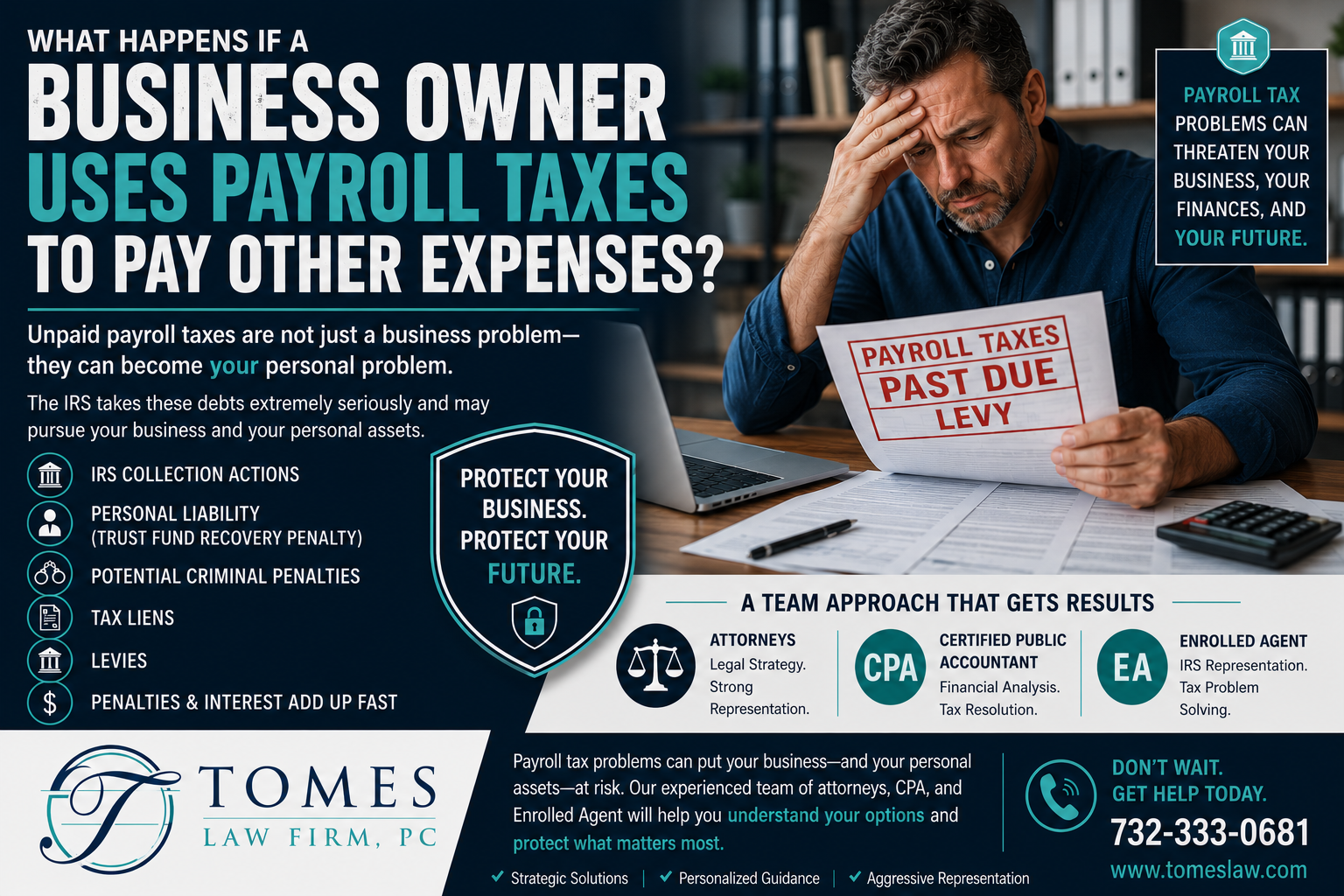
If you own a business and fell behind on payroll taxes, you may feel like you were just trying to survive. Maybe you used payroll tax money to pay rent, vendors, employees, inventory, insurance, or other urgent business expenses. Maybe cash flow was tight, and you thought you could catch up next month. Then next month came, and the IRS balance grew.
If this is happening to your business, you are not alone. Many New Jersey business owners fall behind on payroll taxes during slow seasons, after losing a major customer, during litigation, after a failed expansion, or when expenses rise faster than revenue.
But unpaid payroll taxes are one of the most serious IRS problems a business owner can face.
Why Payroll Taxes Are Different From Other Business Debts
Payroll taxes are not treated like an ordinary business bill.
When your business withholds federal income tax, Social Security tax, and Medicare tax from employees’ paychecks, the IRS views that money as being held “in trust” for the government. In other words, that money does not truly belong to the business.
So when a business owner uses withheld payroll taxes to pay other expenses, the IRS may view it as using government money to fund the business.
That is why payroll tax debt can become personal very quickly.
What Happens If You Don’t Pay Payroll Taxes?
If your business does not pay over payroll taxes, the IRS may take several steps.
1. The IRS Will Send Payroll Tax Notices
At first, you may receive notices showing the unpaid balance, penalties, and interest. These notices may relate to Form 941 payroll tax periods. Many business owners ignore the early notices because they are overwhelmed or hoping cash flow improves. Unfortunately, waiting usually makes the problem worse.
2. Penalties and Interest Add Up Fast
Payroll tax penalties can become significant. The longer the taxes remain unpaid, the more expensive the problem becomes. Even if the original payroll tax balance was manageable, penalties and interest can make the debt feel impossible.
3. The IRS May Demand Business Financial Information
The IRS may ask for bank statements, profit and loss statements, payroll records, accounts receivable information, and proof that current payroll taxes are being paid. Before the IRS agrees to a resolution, it usually wants to see that the business is now compliant.
4. The IRS May File a Tax Lien
A federal tax lien can attach to business property and make it harder to borrow money, sell assets, or keep vendors comfortable. For a business already struggling with cash flow, a tax lien can create even more pressure.
5. The IRS May Levy Business Bank Accounts or Receivables
If the payroll tax problem is not resolved, the IRS may levy business bank accounts or accounts receivable. This can be devastating. A bank levy or receivables levy can interrupt operations and make it difficult to keep the business open. Having your customers receive a levy for your receivables and hearing you have a tax problem and having your receivables diverted to the IRS is not great for business goodwill either.
6. The IRS May Shut Your Business Down
Yes the IRS can shut your business down and padlock it. That is why it important to become compliant quickly and start paying all presently due payroll taxes. If you are on track and showing that you are not compounding the situation, or pyramiding it as the IRS calls it, they will let you continue to operate while a resolution is worked.
The Biggest Risk: Personal Liability
This is the part many business owners do not realize. Even if the payroll taxes were owed by an LLC, corporation, or other business entity, the IRS may still try to hold certain individuals personally responsible through the Trust Fund Recovery Penalty.
The Trust Fund Recovery Penalty can apply to people the IRS believes were responsible for collecting, accounting for, and paying payroll taxes — and who willfully failed to do so. That may include:
- Business owners
- Officers
- Partners
- Managers
- People with check-signing authority
- People who decided which bills got paid
- People who controlled payroll or finances
This means the IRS may try to collect the unpaid trust fund portion from you personally. This is one time where your business structure does not protect you from payroll tax liability. Nor does bankruptcy.
What Does “Willful” Mean?
Many business owners hear the word “willful” and think it means they intentionally tried to cheat the government. That is not always how the IRS looks at it.
In payroll tax cases, “willful” can mean that a responsible person knew payroll taxes were unpaid and chose to pay other creditors instead. That is why using payroll tax money to pay rent, vendors, utilities, or other business expenses can create serious exposure. You may have been trying to keep the doors open, but the IRS may still treat the decision as willful.
Can the IRS Come After Me Personally?
Yes, it can. If the IRS assesses the Trust Fund Recovery Penalty against you, it can collect from your personal assets, wages, bank accounts, or other income sources. This is one of the reasons payroll tax cases should be handled early and carefully.
A business payroll tax problem can become a personal financial crisis if it is ignored.
What If I Used the Money to Keep the Business Open?
This is extremely common. Many business owners tell us:
“I had to choose between paying payroll taxes and paying my employees.”
“I thought I could catch up next quarter.”
“If I didn’t pay vendors, the business would have closed.”
“I used the money to keep people working.”
We understand how these decisions happen. Business owners often make these choices under intense pressure, not because they are trying to avoid responsibility. But the IRS may still pursue collection aggressively. That does not mean you have no options. It means you need a plan.
What Should a New Jersey Business Owner Do If Payroll Taxes Are Past Due?
If your business is behind on payroll taxes, the most important step is to stop the problem from getting worse.
You should:
- File all missing payroll tax returns.
- Make current payroll tax deposits on time.
- Avoid using new payroll tax deposits to pay old expenses.
- Gather IRS notices and payroll records.
- Determine which quarters are unpaid.
- Speak with a tax resolution attorney before meeting with the IRS.
- Do not attend a Form 4180 interview without understanding what is at stake.
What Is a Form 4180 Interview?
A Form 4180 interview is the IRS interview used to determine who may be personally responsible for unpaid payroll taxes. The IRS may ask who signed checks, who had access to bank accounts, who decided which bills were paid, who knew the payroll taxes were unpaid, and who had authority over payroll decisions.
This interview matters. What you say can affect whether the IRS tries to assess the Trust Fund Recovery Penalty against you personally.
Can Payroll Tax Debt Be Resolved?
Yes, but the right strategy depends on the facts. Possible options may include:
- Installment agreements
- Business repayment plans
- Penalty abatement
- Currently Not Collectible status
- Negotiating with the IRS
- Challenging personal liability
- Appealing a proposed Trust Fund Recovery Penalty
- Bankruptcy planning in limited situations
- Closing or restructuring the business when appropriate
The best option depends on whether the business is still operating, whether current deposits are being made, who controlled finances, how much is owed, and whether the IRS has started a personal liability investigation.
Payroll Tax Help for Business Owners in New Jersey
If you are a business owner in New Jersey and your company has unpaid payroll taxes, this is not something to ignore.
Whether your business is in North Jersey, Central Jersey, South Jersey, or the Philadelphia or New York metro area, payroll tax problems can move quickly from business collection to personal liability.
At Tomes Law Firm, we help business owners deal with IRS payroll tax debt, Trust Fund Recovery Penalty investigations, IRS notices, liens, levies, and tax resolution options.
We understand that most business owners did not set out to create a payroll tax problem. You were trying to keep the business alive, protect employees, and survive a difficult period.
But now you need to protect yourself.
When Criminal Risk Increases
The IRS and Department of Justice may consider criminal prosecution when there is evidence that the business owner:
- Intentionally withheld payroll taxes and never intended to remit them
- Repeatedly failed to pay payroll taxes over multiple years
- Filed false payroll tax returns
- Concealed assets or income from the IRS
- Used nominee entities or shell companies to avoid collection
- Engaged in payroll fraud or “off-the-books” payroll
- Diverted funds for personal luxury spending while ignoring payroll tax obligations
- Made false statements to IRS investigators
In those situations, prosecutors may pursue charges such as:
- Failure to collect or pay over employment taxes (26 U.S.C. § 7202)
- Tax evasion (26 U.S.C. § 7201)
- Filing false returns (26 U.S.C. § 7206)
- Conspiracy or fraud-related offenses
Can I Go to Jail for Unpaid Payroll Taxes?
This is often the first question worried business owners ask.
The answer is that criminal prosecution is possible, but it is not the outcome in most payroll tax cases. Most business owners who fall behind on payroll taxes are not trying to commit fraud. They are trying to keep their businesses alive. They are paying employees, covering rent, satisfying critical vendors, and doing everything they can to survive a difficult financial situation.
In most cases, the IRS initially treats unpaid payroll taxes as a civil tax matter. The agency may assess penalties, file tax liens, levy accounts, or pursue personal liability through the Trust Fund Recovery Penalty.
However, payroll taxes are taken very seriously because the money was withheld from employees’ paychecks and is considered trust fund money belonging to the government. In certain circumstances, criminal penalties may become a concern. The IRS and Department of Justice may investigate cases involving:
- Intentional failure to pay payroll taxes over an extended period
- False payroll tax returns
- Concealment of assets or income
- Payroll fraud
- False statements made during an IRS investigation
- Other conduct suggesting an intent to evade taxes
The important thing to understand is that the earlier you address the problem, the more options you typically have available.
Many business owners wait because they are afraid of what the IRS might do. Unfortunately, waiting often allows the problem to grow larger and limits available resolution options.
If your business has unpaid payroll taxes, it is generally better to take action before the IRS escalates its collection efforts or begins investigating who may be personally responsible or worse sends your matter to their Criminal Investigation branch.
Why Business Owners Choose Tomes Law Firm
Payroll tax cases are complex because they involve both business and personal liability issues.
At Tomes Law Firm, our clients benefit from a team approach that combines legal, tax, and IRS representation experience. Not every tax professional can handle every IRS problem — and most can’t handle all of them. The most serious situations call for a team with Enrolled Agents, CPAs, and tax attorneys under one roof. That’s exactly what Tomes Law Firm offers.
Here’s why that matters for small business owners:
- Enrolled Agents (EAs) — Licensed directly by the IRS and required to complete ongoing tax law education every year. Tomes Law Firm’s EAs handle IRS negotiations, installment agreements, penalty abatement requests, and day-to-day resolution work with precision and efficiency. Our EA was a former Revenue Officer with the IRS and he knows all the regulations and how the IRS works internally.
- CPAs (Certified Public Accountants) — When accounting errors, financial records, or business tax complexity are part of the picture, having a CPA on your team means nothing gets missed. Tomes Law Firm’s CPAs dig into the numbers so your case is built on solid ground. Our CPA also has solid CFO experience helping businesses grow. We can help you get
- Tax Attorneys — For the most serious situations — Trust Fund Recovery Penalties, tax liens, levies, criminal exposure, or disputes headed toward U.S. Tax Court — you need legal representation, not just tax expertise. Tomes Law Firm’s attorneys bring both, not just a solid knowledge of the Tax Code but years handling court litigation against some of the biggest powerhouse corporations in mass tort cases and class actions lawsuits. Payroll taxes in New Jersey could also include State Payroll Issues, so you need a licensed New Jersey attorney to help you if your State Case goes to court as well.
Most tax resolution firms have one or two of these. Tomes Law Firm has all three, working together on your case. That means no handoffs, no gaps, and no situation too complex to handle. Always verify credentials: use the IRS directory of credentialed tax professionals for Enrolled Agents and CPAs, and the New Jersey Courts Attorney Search to verify the license and standing of any New Jersey attorney.
One word of caution when shopping around: be wary of large national “tax relief” companies that make big promises upfront, charge significant fees before doing any real work, and connect you with someone in a call center across the country who doesn’t know New Jersey tax law, New Jersey businesses, or you.
We don’t simply look at the legal issues.
We examine:
- IRS collection exposure
- Trust Fund Recovery Penalty risks
- Financial records
- Business operations
- Tax compliance issues
- Resolution and negotiation opportunities
Many firms offer legal representation. Others offer accounting services.
Our clients benefit from a team that understands both.
When your business is facing payroll tax debt, you need more than general advice. You need a strategy built around protecting your business, your personal assets, and your future.
Don’t Wait Until the IRS Makes the Next Move
Most business owners wait too long. They hope business will improve. They hope they can catch up. They hope the problem will somehow resolve itself. Unfortunately, payroll tax problems rarely get better with time.
The sooner you understand your risks and options, the sooner you can begin taking control of the situation. If your business owes payroll taxes or you have received notices regarding a Trust Fund Recovery Penalty investigation, contact Tomes Law Firm today. at 732-333-0681 or 833-4IRS-TAX.
.