
 Office in Freehold NJ |
By Tomes Law Firm
Opening an envelope from the IRS is stressful on a good day. But when the letter inside says “Notice of Intent to Levy,” it can feel like the floor has dropped out from under you. Your mind races : Can they really take my paycheck? My bank account? My home?
Take a breath. You are not without options, and you are not alone. This notice is serious, but it is not the end of the road. Understanding exactly what happens next and what you can do about it is the first step toward getting through this.
What Is a Notice of Intent to Levy?
The IRS is required by law to give you fair warning before it can seize your assets. A Notice of Intent to Levy (typically IRS Letter 1058 or LT11 or a CP 504) is that warning. It means the IRS has determined you have an unpaid tax balance, has made previous attempts to collect it, and is now telling you it plans to take action if you do not respond.
This notice also informs you of your right to a hearing which is one of your most important protections but requires action.
What Can the IRS Actually Levy?
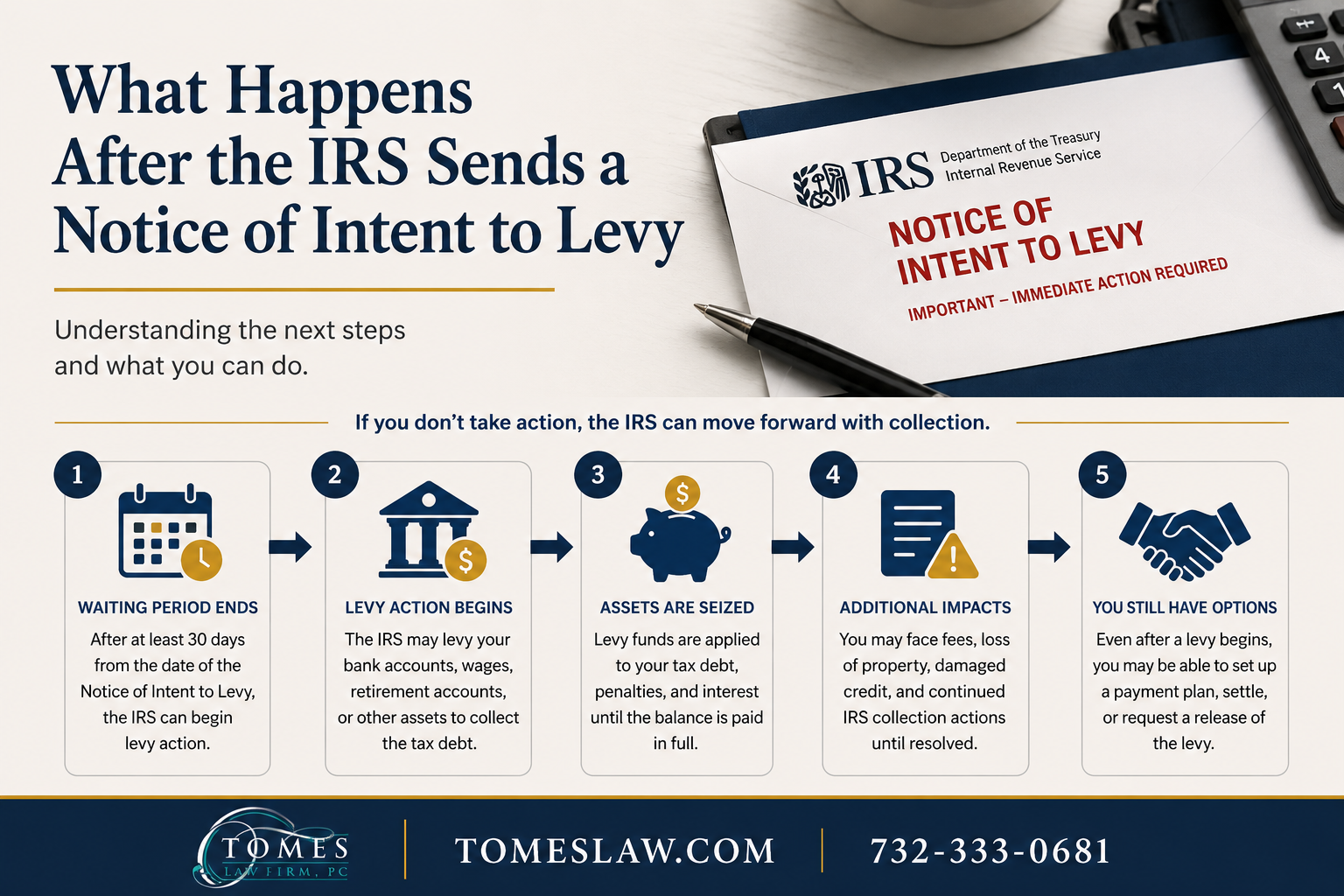
A levy is not just a scary word. It is the legal seizure of your property to satisfy a tax debt. Once the IRS moves forward, it has broad authority to take:
- Wages and salary: the IRS can notify your employer to withhold a portion of every paycheck, and it is not just the 10% other creditors can take, it is way more.
- Bank accounts : funds can be frozen and seized, often with little additional warning
- Social Security benefits: yes for real
- Accounts receivable (for business owners)
- Real property, including your home, in more serious cases
- Retirement accounts and other financial assets
The reach of an IRS levy is wider than most people realize, which is why acting quickly matters so much.
How Much Time Do You Have?
The notice gives you 30 days to respond before the IRS can begin levying. This window is critical. It is not a suggestion. It is a deadline with real consequences. If you miss it without taking action, the IRS can move forward with collection without further notice to you.
Thirty days can feel like a long time when you first open the letter, but it goes quickly. Do not wait.
Your Rights After Receiving This Notice
This is where many people are surprised: you have meaningful rights at this stage, and the IRS is required to respect them.
1. The Right to a Collection Due Process (CDP) Hearing
Within 30 days of the notice date, you can request a CDP hearing with the IRS Office of Appeals. This is not just a formality but a legitimate opportunity to:
- Challenge whether you actually owe the amount the IRS claims
- Propose alternative payment arrangements
- Request currently-not-collectible status if you are facing genuine financial hardship
- Explore options like an Offer in Compromise
Critically, requesting a CDP hearing also stops levy action while your case is under review. That alone can buy you meaningful time and breathing room.
2. The Right to Propose a Payment Plan
If you owe the taxes but simply cannot pay them all at once, an installment agreement may be available to you. Getting into an approved payment plan can stop levy action in its tracks.
3. The Right to an Offer in Compromise
Under certain circumstances, the IRS will accept less than the full amount owed. An Offer in Compromise is not available to everyone, but for those who qualify, it can be life-changing.
4. The Right to Claim Financial Hardship
If paying your tax debt would leave you unable to meet basic living expenses, you may qualify to have your account placed in “currently not collectible” status. This does not erase the debt, but it does pause collection activity while you stabilize.
What Happens If You Do Nothing
We understand that ignoring a scary letter can feel easier in the moment. But with IRS notices, silence is treated as consent. If the 30-day window passes without any response or action on your part:
- The IRS can begin levying your bank accounts and wages immediately
- Bank levies are typically a one-time seizure of whatever is in your account on the day the levy hits — often without additional warning.
- Wage garnishments are ongoing, meaning a portion of every paycheck is withheld until the debt is paid
- The IRS may file a federal tax lien against your property, which affects your credit and your ability to sell or refinance a home
None of these outcomes are inevitable. But they become far more likely once that 30-day window closes.
What You Should Do Right Now
Step 1: Do not panic, but do act. You have time, but not unlimited time. Use the next few days to gather your documents and understand what you owe.
Step 2: Read the notice carefully. Note the date on the letter, the amount the IRS claims you owe, and the deadline for requesting a CDP hearing. These details matter.
Step 3: Do not call the IRS alone. Many people try to handle this themselves and accidentally waive rights or agree to arrangements that are not in their best interest. The IRS is skilled at what it does. It is their job to get your money as quickly as possible. You deserve an advocate who is skilled too.
Step 4: Contact a tax attorney. This is not the time for a general practitioner or a tax preparer. A tax attorney understands the procedural rules, knows how to negotiate with the IRS, and can evaluate every option available to you — including ones you may not know exist. At Tomes Law Firm, our team brings together experienced tax attorneys, litigation specialists, accountants, and federal tax practitioners — giving you a full bench of professionals who know the IRS from every angle and can build the strongest possible strategy for your situation.
A Word About How You May Be Feeling
If you are dealing with an IRS levy notice, chances are this did not come out of nowhere. Tax debt often builds quietly — during a difficult year, a business that struggled, a life event that disrupted everything. The shame and fear that come with this kind of letter are real, and we see them in the faces of the people who walk through our door every day.
You are not a bad person because you owe the IRS money. You are a person in a difficult situation that has a path forward. Our job is to help you find it.
Tomes Law Firm Is Here to Help
At Tomes Law Firm, we work with individuals and families navigating exactly this kind of situation. We understand the IRS’s playbook — all 17,472 pages of it, spread across 22 volumes of federal tax regulations — and we know how to protect your rights, your income, and your assets at every stage of the process.
If you have received a Notice of Intent to Levy, do not wait. Contact us today at 732-333-0861 or 833-4IRS-TAX for a confidential consultation. The sooner we can review your situation, the more options we have available to you.