
 Office in Freehold NJ |
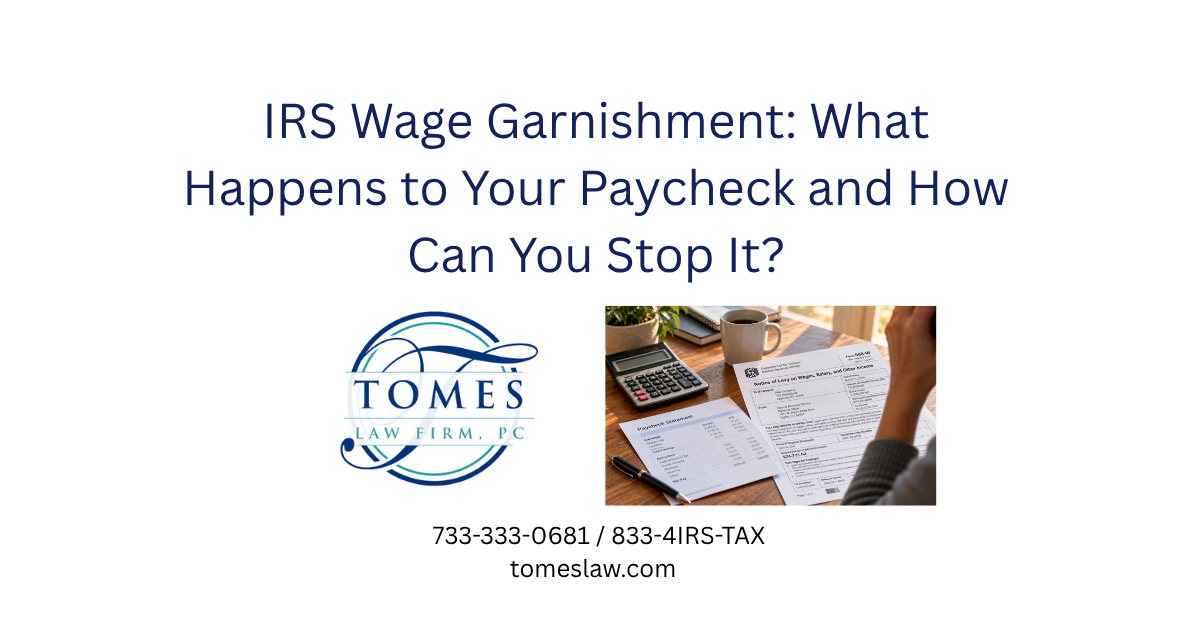
: IRS wage garnishment means the IRS can require your employer to send part of each paycheck toward unpaid federal taxes. It can continue payday after payday. But you may be able to stop or reduce it by fixing the tax problem, arranging payments, or showing that the levy keeps you from paying necessary living expenses.
Why Did the IRS Garnish My Wages?
Usually, IRS wage garnishment does not start with a surprise court case. The IRS can use a tax levy without first suing you. In most cases, it first assesses a tax, sends a bill, and gives a final notice of its plan to levy along with a chance to ask for a hearing. That notice generally comes at least 30 days before the levy, although there are exceptions.
Different IRS letters mean different things. Do not assume that every letter marked “final notice” gives the same appeal rights. Look at the notice number, the date, and the deadline. A missed deadline can take away important options.
What Happens When an IRS Wage Garnishment Reaches Your Employer?
The IRS normally sends your employer Form 668-W, Notice of Levy on Wages, Salary, and Other Income. Your employer must follow it. Money above the amount protected by IRS rules is sent to the IRS, and the levy generally stays in effect until the IRS releases it, the debt is paid, or another lawful stopping point applies.
Your employer should give you a Statement of Dependents and Filing Status to complete. The IRS says you have three days to return it. If you miss that period, your employer must initially use the less favorable married-filing-separately, zero-dependents calculation. You can submit the statement later to correct the exempt amount, but you should act right away.
How Much of My Paycheck Can IRS Wage Garnishment Take in 2026?
There is no single percentage that applies to everyone. The amount you keep depends mainly on your filing status, dependents, pay schedule, and any additional exemption that applies. Employers use IRS Publication 1494 for the year the levy is served.
For example, the 2026 IRS table protects $619.23 of take-home pay every two weeks for a single taxpayer with no dependents and no additional exemption. If that person has $1,800 in take-home pay for the period, as much as $1,180.77 could be subject to the levy under this basic example. Actual calculations can change with other income, allowed adjustments, and the facts of the levy.
Those IRS table amounts are not a finding that your rent, food, utilities, and medical bills fit into that small amount. If the levy leaves you unable to meet basic, reasonable living expenses, a separate financial-hardship request may be available.
Can I Stop IRS Wage Garnishment Once It Has Started?
Often there is a way forward, but an existing wage levy does not disappear merely because you call the IRS or send an application. The IRS generally must communicate the release to your employer. Depending on the case, a solution may involve:
- An installment agreement that permits the levy to be released, rather than simply leaving the deduction in place.
- Currently Not Collectible status or a financial-hardship request when the levy prevents you from paying basic, reasonable living expenses.
- An Offer in Compromise if your finances support settlement for less than the full debt. An offer is not automatic forgiveness or an instant levy release.
- A challenge when the levy was issued incorrectly, the debt has already been paid, or collection authority has expired.
The IRS may grant a full or partial release depending on what is needed to address hardship. A levy release does not erase the tax debt. You still need a plan for the balance.
Related reading: IRS Tax Debt Relief and Offer in Compromise.
What Should I Do Before My Next Payday?
- Get the Form 668-W from payroll and complete the dependent and filing-status statement right away.
- Gather your IRS notices, current pay stubs, bank statements, rent or mortgage costs, utilities, medical bills, and other necessary expenses.
- Call the IRS number on the levy or have your authorized tax attorney contact the IRS. Explain any immediate hardship and request a release.
- Find out who at your employer handles payroll levies. A release sent promptly to the right fax number or department can matter.
- If you received a notice with Collection Due Process hearing rights, check its exact deadline immediately. In many cases the request deadline is 30 days from the notice date.
If the levy already took a paycheck, ask whether any proceeds can be returned. Return of levied money is not automatic and depends on the reason, timing, and applicable rules.
Does New Jersey Have Different Rules?
If your employer is in New Jersey but the debt is federal income tax, the IRS wage-levy rules discussed here apply. Do not confuse an IRS wage levy with the limits that may apply to an ordinary creditor’s wage garnishment.
New Jersey state tax debts are a separate matter. The New Jersey Division of Taxation has its own notice and collection process, which can include a Certificate of Debt entered in Superior Court. If you owe both federal and New Jersey taxes, the notices and remedies need to be reviewed separately.
Learn more about the firm’s New Jersey tax-law services.
How We Helped Dan Get His IRS Wage Levy Released
Dan normally brought home about $1,370 a week from his job. Then the IRS began taking money from his wages. On one paycheck, even after working a few hours of overtime, Dan was left with just $288 for the entire week. The IRS had taken $1,136.
Think about that. Dan had worked extra hours, but he still had just $288 left to pay for groceries, utilities, transportation, and everything else he needed that week.
When Dan came to Tomes Law Firm, we worked to get the levy released. It was not an overnight fix. We negotiated with the IRS for two months before we secured the release.
Dan’s story shows how hard an IRS wage garnishment can hit a working person. It also shows that a levy does not have to be the end of the story. Getting relief may take financial records, careful negotiation, and persistence. The right solution depends on the taxpayer’s circumstances.
Why Have a Tax Attorney Handle IRS Wage Garnishment?
When the IRS is taking money from your paycheck, you need more than a promise that someone can “stop garnishment.” You need someone to check the account, read the notices, calculate what the law protects, and work through the right solution.
At Tomes Law Firm, we review the financial information you may need to disclose, including income, assets, and living expenses. The IRS does not automatically allow every expense you pay. Certain necessary costs above its usual standards may need a clear explanation and proof. We work to present a complete and accurate picture of what you can actually afford while protecting available appeal rights and following through with the employer on any levy release.
IRS Wage Garnishment: Frequently Asked Questions
Can the IRS garnish my wages without a court judgment?
Yes. For unpaid federal taxes, the IRS generally does not need a court judgment first. It must follow the applicable notice and collection procedures, with some exceptions.
Will an IRS payment plan stop wage garnishment?
It may. If you enter an installment agreement whose terms do not allow the levy to continue, the IRS must release it. Ask about the existing levy specifically and confirm that payroll receives the release.
Can the IRS take my entire paycheck?
Usually part of your pay is exempt under federal levy tables. But the protected amount may be small, and special rules, including the allocation of exemptions when you have other income, can affect a particular paycheck.
What if I cannot pay rent after the IRS takes my wages?
Contact the IRS immediately and explain the hardship. Be ready to document necessary expenses. When the IRS determines the levy keeps you from meeting basic, reasonable living expenses, it must provide the release needed to relieve that hardship.
Can I challenge an IRS wage levy?
Yes. Your options may include a timely Collection Due Process hearing or the Collection Appeals Program, depending on the notice and stage of collection. The deadlines and rights are not identical, so the exact notice matters.
Facing an IRS Wage Garnishment in New Jersey?
The next paycheck matters. If the IRS has contacted your employer or sent you a final levy notice, contact Tomes Law Firm in Freehold, New Jersey. We can review the notices, explain your options, and help you take the next step before more money is withheld.
Call the tax resolution attorneys and accountants at 732-333-0681 or 833-4IRS-TAX to request a confidential free initial consultation, or visit tomeslaw.com.
We Solve Tax Problems. You Get Peace of Mind.