
 Office in Freehold NJ |
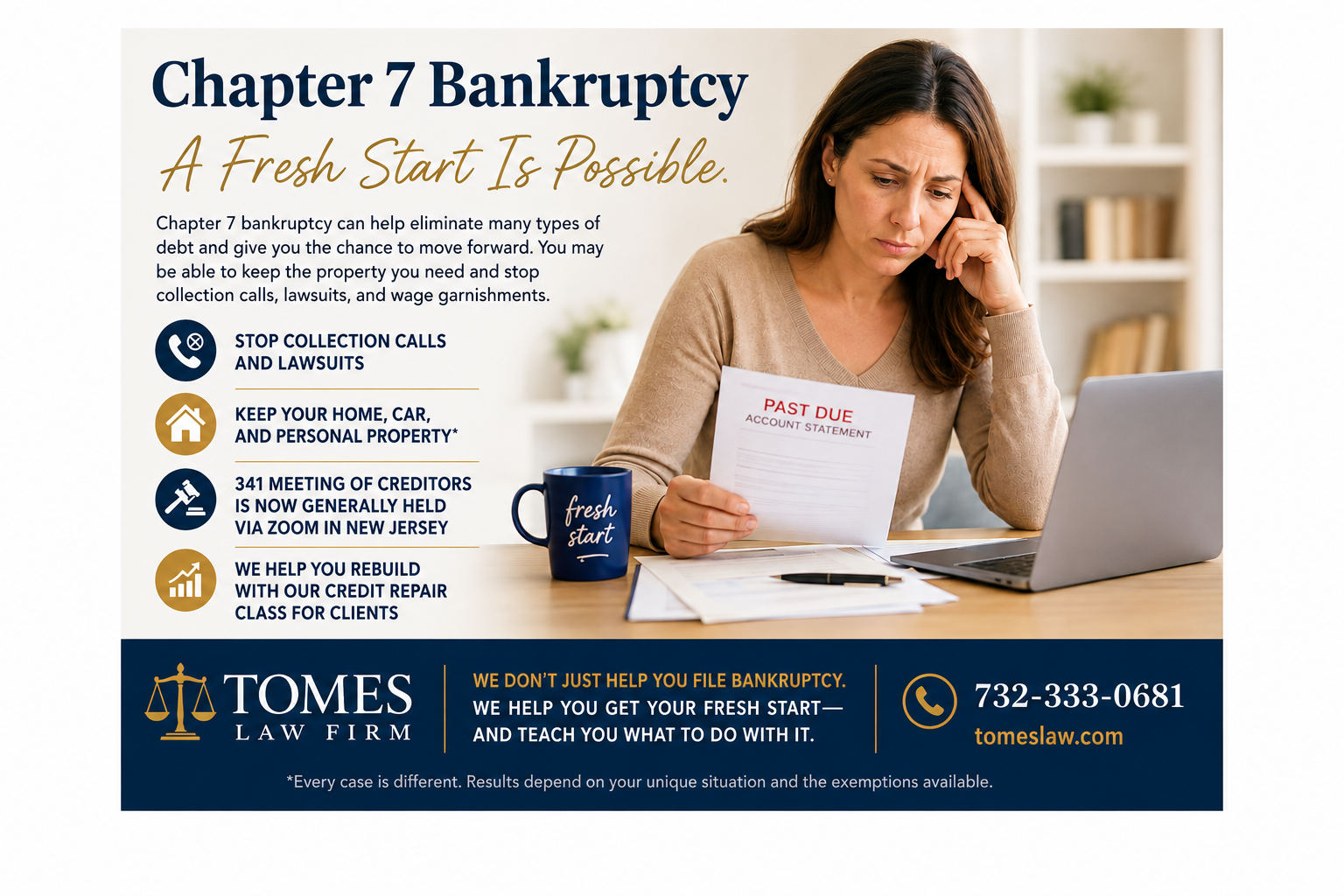
If I file Chapter 7 bankruptcy, am I going to lose everything? For many people, the answer is no.
If you are thinking about bankruptcy, you may be scared about what happens next.
You may be lying awake wondering how you are going to pay the credit cards. You may be afraid to answer your phone because another bill collector is calling. You may be worried that someone will sue you, take money from your paycheck, or freeze your bank account. Chapter 7 bankruptcy can eliminate many types of debt and give you a chance to start over. Many people who file Chapter 7 are able to keep the property they need for everyday life.
But Chapter 7 is not right for everyone. Before filing, you need to understand what happens to your debts, your property, your income, and your financial future.
Chapter 7 Quick Facts
- Chapter 7 can eliminate many credit cards, medical bills, personal loans, and other unsecured debts.
- Filing generally stops many collection actions through the automatic stay.
- You do not automatically lose your house, car, retirement money, or personal property.
- Your income and other circumstances determine whether you qualify.
- A typical Chapter 7 case may be completed within a few months.
- New Jersey Chapter 7 Meetings of Creditors are currently generally conducted virtually through Zoom.
- Bankruptcy requires credit counseling before filing and debtor education after filing.
- Tomes Law Firm clients are also enrolled in our credit repair class to help them begin rebuilding after bankruptcy.
What Is Chapter 7 Bankruptcy?
Chapter 7 is a type of bankruptcy designed to give qualifying individuals a fresh financial start.
When you file a Chapter 7 case, federal bankruptcy law can protect you from many collection actions and may allow you to eliminate, or discharge, many of your debts.
Chapter 7 is sometimes called a “liquidation bankruptcy.”
That name scares people.
They hear “liquidation” and think:
They are going to take everything I own.
That is not how most consumer Chapter 7 cases work.
Bankruptcy law provides exemptions that can protect certain property.
The important question is not simply what you own. It is:
What do you own, what is it worth, what do you owe against it, and which bankruptcy exemptions apply to you?
Those questions need to be answered before you file.
What If I Am Paying My Bills but the Debt Is Not Going Down?
You do not have to be behind on every bill before you have a serious debt problem.
We represented a client we will call Andrea. Her name and identifying details have been changed to protect her privacy.
Andrea had about $50,000 in debt.
She was paying more than $1,000 every month just toward her credit card minimum payments.
She was doing what she thought she was supposed to do.
She kept paying.
But there was a problem.
The balances were not going down.
Month after month, more than $1,000 was leaving her bank account, but she was not getting closer to being debt-free.
That is more than $12,000 a year going toward minimum payments while the debt continues to control your life.
Andrea did not come to us because she did not want to pay her bills.
She came to us because what she was doing was not working.
We see this often.
People cut expenses.
They move balances from one credit card to another.
They make minimum payments.
They use one card because there is not enough money left after paying another.
Eventually, they realize they are spending a large part of their income just trying to stay in the same place.
Chapter 7 can sometimes break that cycle.
The question is not simply:
“Can I make another minimum payment this month?”
A better question may be:
“Is what I am doing actually getting me out of debt?”
What Debts Can Chapter 7 Eliminate?
Chapter 7 can discharge many common unsecured debts, including:
- Credit card debt
- Medical bills
- Personal loans
- Old utility bills
- Many collection accounts
- Certain lawsuit judgments
- Some older income tax debts if very specific requirements are met
Not every debt goes away.
For example, child support and alimony generally survive bankruptcy. Most student loans are not automatically discharged. Some tax debts also remain due.
That is why we look at each client’s debts before recommending bankruptcy.
The goal is not simply to file bankruptcy.
The goal is to determine whether bankruptcy will actually solve your financial problem.
How Much Debt Do I Need to File Chapter 7?
There is no simple minimum amount of debt that makes someone a Chapter 7 candidate.
For one family, $20,000 of credit-card debt may be impossible to manage.
Another family may owe much more but have enough income to comfortably pay it.
The amount of debt is only part of the picture.
We also look at:
- Your income
- Your monthly living expenses
- Your assets
- Your family size
- Whether you are being sued
- Whether your wages or bank account are at risk
- Whether your debt is actually getting smaller
- Whether you could realistically pay the debt within a reasonable time
There is no magic number.
The real question is whether the debt has become unmanageable.
Will I Lose My House If I File Chapter 7?
Not necessarily.
This is one of the biggest fears we hear.
Whether your house is at risk depends on several things, including:
- What the house is worth
- What you owe on your mortgage
- Whether there are other liens
- How much equity you have
- Which bankruptcy exemptions you can use
- Whether you are current on your mortgage
If the equity in your home is protected by an available exemption, you may be able to keep your home.
A person with substantial unprotected equity may have a very different situation.
That is why we calculate the numbers before filing the case.
Can I Keep My Car?
Many Chapter 7 filers keep their cars.
The answer depends on the value of the vehicle, how much you owe on it, the available exemptions, and whether you can continue making any required loan payments.
If you have a car loan, bankruptcy does not automatically give you the vehicle free and clear.
The car loan and your ownership of the vehicle need to be reviewed as part of the bankruptcy analysis.
What Happens to My Paycheck and Bank Account?
Filing Chapter 7 does not ordinarily mean that the bankruptcy trustee takes all of your future paychecks.
But money you already have when the bankruptcy is filed is different.
Money in checking and savings accounts must be disclosed.
Whether that money is protected depends on the amount, the source of the funds, and the exemptions available in your case.
This is another reason timing matters.
Do not move money around, empty accounts, or give money to someone else because you think that will protect it.
Talk with a bankruptcy attorney first.
What Happens to My 401(k) or Retirement Money?
Many qualified retirement accounts have significant protection under federal law.
That can include certain 401(k)s, pensions, and other qualified retirement plans.
This leads to an important warning:
Do not automatically cash out retirement funds to pay credit cards before talking with a bankruptcy attorney.
We have seen people use protected retirement money trying to keep up with debt they ultimately could not afford anyway.
Taking money out of retirement can also create a tax problem.
You could lose money that might otherwise have been protected and create taxable income at the same time.
Before using retirement savings to deal with overwhelming debt, find out what your options are.
What Should I NOT Do Before Filing Chapter 7?
When people become worried about losing property, they sometimes try to “protect” it themselves.
That can make the problem worse.
Before filing bankruptcy, do not make major financial moves without getting advice.
That includes things such as:
- Transferring your house or car to a family member
- Giving money or property away
- Repaying large amounts to relatives
- Moving money between accounts to hide it
- Cashing out retirement accounts
- Running up credit cards
- Taking large cash advances
- Selling property for less than it is worth
Bankruptcy requires you to disclose your assets and many recent financial transactions.
Trying to hide or move property can create serious problems.
Sometimes the thing you are trying to “protect” may already be protected by bankruptcy law.
Get advice before you move it.
Who Qualifies for Chapter 7 Bankruptcy?
Chapter 7 is not available to everyone.
One part of the qualification process is called the means test.
The means test looks at household income and other information to determine whether you qualify for Chapter 7 under the Bankruptcy Code.
But it is not as simple as:
“I make too much money.”
Household size, the type of income you receive, allowable expenses, and other circumstances can matter.
We also look beyond the means test.
We review your:
- Assets
- Debts
- Income
- Expenses
- Tax returns
- Recent financial transactions
- Lawsuits
- Property
- Overall financial situation
Only then can we determine whether Chapter 7 makes sense.
What Happens When I File?
One of the most important protections in bankruptcy is called the automatic stay.
In many cases, the automatic stay begins when the bankruptcy is filed and stops many collection activities.
That may stop or pause:
- Collection calls
- Collection letters
- Lawsuits
- Wage garnishments
- Bank levies
- Other collection efforts
There are exceptions, so the automatic stay does not solve every problem.
But for someone who has been living under constant collection pressure, it can provide important legal protection.
Will Everyone Know I Filed Bankruptcy?
Bankruptcy is a public court proceeding.
But that does not mean the court sends an announcement to your friends, neighbors, or coworkers.
Your creditors and other parties who are legally entitled to notice will receive notice of the case.
Most people’s friends and neighbors would have no reason to know about the bankruptcy unless they searched public court records or you told them.
Your employer is not automatically contacted simply because you filed Chapter 7.
There may be circumstances where an employer or payroll department becomes involved—for example, if a bankruptcy filing stops an existing wage garnishment.
If privacy is a particular concern, tell your attorney so you understand how your specific situation will be handled.
Will I Have to Go to Court?
One of the things that scares people about bankruptcy is imagining themselves standing in a courtroom in front of a judge.
For most routine Chapter 7 cases, that is not what happens.
You will have to attend a Meeting of Creditors, also called a 341 meeting.
Right now in New Jersey, Chapter 7 341 meetings are generally conducted virtually through Zoom, rather than in a courtroom.
The meeting is conducted by the bankruptcy trustee.
There is no judge at the meeting.
The trustee will put you under oath and ask questions about your bankruptcy papers, income, debts, property, and financial history.
Creditors are allowed to attend and ask questions, although creditors often do not appear in routine consumer Chapter 7 cases.
If you are a Tomes Law Firm client, we prepare you before the meeting so you know what to expect. Your attorney also attends the virtual meeting with you.
If your trustee or attorney directs you to appear another way, you must follow those instructions.
For many clients, the 341 meeting turns out to be much less frightening than they imagined.
Are There Classes I Have to Take?
Yes.
There are two bankruptcy education requirements.
First, you generally must complete an approved credit counseling course before filing bankruptcy.
After your case is filed, you must complete a separate debtor education course before you can receive your bankruptcy discharge, subject to limited exceptions.
These are required bankruptcy courses.
They are different from the additional credit-repair education Tomes Law Firm provides to our bankruptcy clients.
What Happens to My Credit After Chapter 7?
A Chapter 7 bankruptcy can remain on your credit report for years.
But that does not mean you have to wait years before you begin rebuilding your credit.
Many people who come to us already have credit problems caused by late payments, collections, high balances, or lawsuits.
Bankruptcy can sometimes become the point where rebuilding begins.
That is why, after filing, Tomes Law Firm bankruptcy clients are enrolled in our credit repair class.
The class is designed to help clients learn how to begin improving their credit after bankruptcy.
We want our clients to understand how to:
- Review their credit reports
- Understand what affects a credit score
- Begin rebuilding positive credit
- Use new credit carefully
- Pay bills in a way that supports better financial habits
- Avoid falling back into the same debt cycle
- Begin building a stronger financial future
We cannot promise anyone a particular credit score or how quickly a score will change.
But we can give our clients education and tools to help them move in the right direction.
For us, a bankruptcy case is not just about getting a discharge.
It is about helping you get your fresh start—and teaching you what to do with it.
How Long Does Chapter 7 Take?
A straightforward Chapter 7 case often takes only a few months from filing to discharge.
More complicated cases can take longer.
The timeline may be affected by issues involving:
- Assets
- Creditors
- Missing documents
- Tax returns
- Objections
- Other financial or legal issues
Every case is different.
What Happens If You Do Nothing?
Bankruptcy should not be filed simply because you owe money.
But doing nothing also has consequences.
If you cannot realistically repay your debt, waiting may mean:
- More interest
- More late fees
- More collection calls
- More lawsuits
- Wage garnishments
- Bank levies
- Years spent making payments without making real progress
Sometimes the most important question is not:
“Do I want to file bankruptcy?”
It is:
“What will my financial life look like a year from now if nothing changes?”
Chapter 7 Is About More Than Getting Rid of Debt
In our experience helping New Jersey families with serious debt problems, people rarely walk into our office excited about bankruptcy.
They usually come in worried.
Embarrassed.
Exhausted.
Sometimes afraid.
Many have spent months or years trying to fix the problem themselves.
Our job is not to tell everyone to file bankruptcy.
Our job is to look at the entire financial picture and help determine the best way forward.
Sometimes that is Chapter 7.
Sometimes it is Chapter 13.
Sometimes there is another solution.
But you cannot make that decision until you understand what your choices really are.
Frequently Asked Questions About Chapter 7 Bankruptcy in New Jersey
Can Chapter 7 wipe out credit card debt?
In many cases, yes. Ordinary credit card debt is generally dischargeable, although exceptions can apply.
Can Chapter 7 eliminate tax debt?
Sometimes. Certain older income tax debts may qualify for discharge, but the rules are strict. When a return was due, when it was filed, when the tax was assessed, collection events, and other facts can all matter. If you owe taxes as well as other debt, the tax debt should be reviewed carefully before filing bankruptcy.
Can I file Chapter 7 if I have a job?
Yes. Having a job does not automatically prevent you from filing Chapter 7. Your income, household size, expenses, and other circumstances must be reviewed.
Can married people file bankruptcy separately?
Yes. A married person may be able to file without their spouse. However, the non-filing spouse’s income, jointly owned property, and joint debts may still affect the analysis.
Do I have to be behind on my bills to file Chapter 7?
No. Andrea’s story is a good example. Someone can be making minimum payments every month and still have a debt problem if the balances are barely moving and the payments are consuming money needed for ordinary life.
Should I stop paying my bills before filing bankruptcy?
Do not make major financial decisions based only on general information online. Which bills should continue to be paid depends on your circumstances, especially if a home, vehicle, taxes, support obligation, or secured debt is involved.
Learn Your Options Before Making a Decision
If debt is taking over your life, you do not have to decide today that you are filing bankruptcy.
The first step is understanding your options.
At Tomes Law Firm, we help New Jersey individuals and families look at the entire financial problem – not just the bankruptcy forms.
We can review your debts, income, property, tax issues, lawsuits, and other concerns and help you understand whether Chapter 7, Chapter 13, or another solution may make sense.
And if bankruptcy is the right solution, our goal is not simply to get you through the filing.
We want to help you get the fresh start and then begin building what comes next.
If you are struggling with financial issues contact Tomes Law Firm today at 732-333-0681 for a free confidential consultation.