
 Office in Freehold NJ |

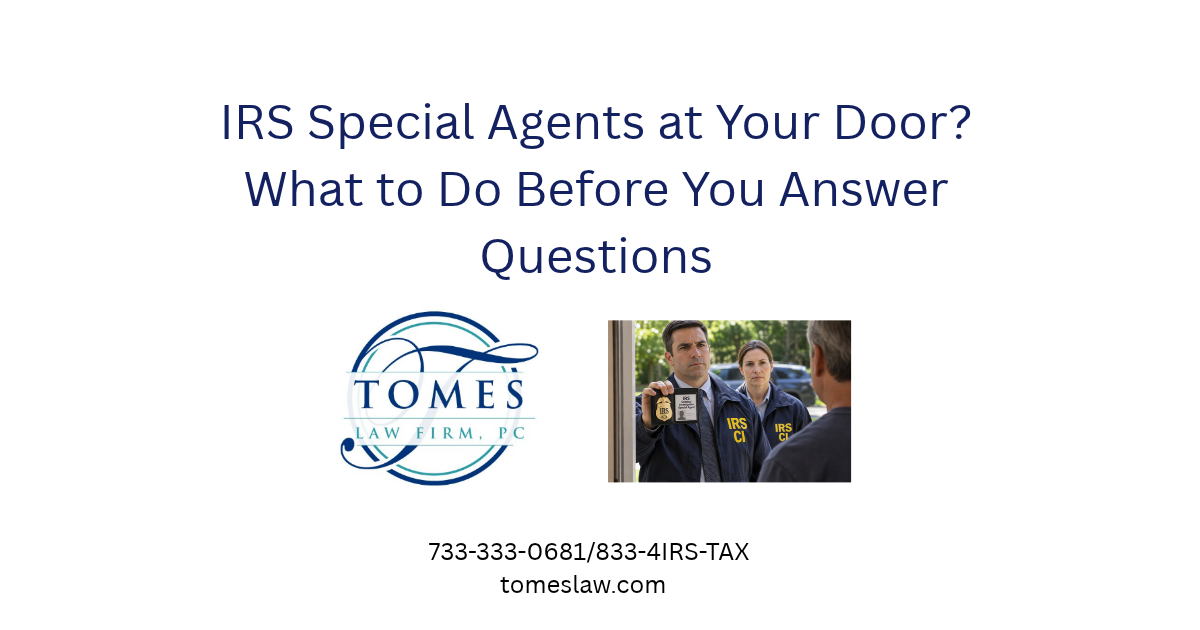
Two IRS special agents arrive at your door of your home or business. They show their badges and say they only want to ask a few questions. Do you have to answer?
No. You generally do not have to participate in a voluntary interview when Special Agents show up at your door. . You can decline to answer questions and ask to have an attorney present even if agents say you are only a witness. Tomes Law Firm represents individuals and business owners facing serious IRS tax investigations. Contact Tomes Law Firm before answering an questions.
A visit from IRS Criminal Investigation (IRS-CI) does not automatically mean you will be arrested or charged. But it is serious, and statements made during an interview may be used as evidence.
IRS Special Agents at Your Door: Five Steps
Stay calm and ask to see the agents’ identification.
Ask whether they have a warrant. Do not physically interfere with lawful action.
Politely decline voluntary questioning until you have consulted an attorney.
Do not consent to a voluntary search or hand over records without legal advice; comply with valid compulsory process.
Preserve records, write down what occurred, and contact an attorney experienced in criminal tax matters.
You can say: “I would like to speak with my attorney before answering questions. I do not consent to a voluntary search.”
Who Are IRS Criminal Investigation Special Agents?
IRS-CI special agents are federal law enforcement officers, unlike IRS revenue agents who perform civil audits or revenue officers who collect taxes. Special agents investigate suspected criminal violations and other financial crimes. Examples include tax evasion, intentionally false returns, unreported business income, off-the-books payroll, fraudulent refund claims, tax preparer fraud, PPP or EIDL fraud, and certain money-laundering offenses.
An investigation is not a conviction. The government must establish the elements of any particular offense; an ordinary mistake or inability to pay taxes does not automatically prove criminal tax fraud.
1. Ask Who They Are and Whether They Have a Warrant
Ask to see credentials and note the agents’ names and contact information. You may verify their identities using an IRS number you obtain independently. Ask whether they have a search or arrest warrant.
Without a warrant, agents generally cannot enter a private home merely because they want to talk, although consent and recognized exceptions to the warrant requirement can permit entry. You may decline consent. If agents have a valid warrant, do not block or obstruct them. Request a copy and contact counsel immediately. The scope and legality of a search depend on the specific warrant and circumstances.
2. You Do Not Have to Agree to a Voluntary Interview
An agent’s request to “ask a few questions” is not automatically a legal obligation to answer. You can politely say: “I understand you would like to speak with me. I do not wish to answer questions without my attorney present.” You do not need to explain your tax returns, bank deposits, payroll practices, or business records at the door.
Never lie, make up answers, or supply false documents. Declining a voluntary interview is different from disregarding a lawful subpoena, IRS summons, or court order; have an attorney review any such demand promptly.
3. “You Are Just a Witness” Does Not Take Away Your Right to Counsel
Agents may say they are investigating someone else perhaps your employer, accountant, business partner, or customer—and that you are only a witness. That may be true. Nevertheless, a witness in an IRS criminal investigation has the right to be accompanied, represented, and advised by counsel. You can decline a voluntary interview until you have spoken to an attorney.
You may say: “I understand you are seeking information as a witness. I would like my attorney present before I answer questions.” This also applies to employees approached at work. A witness’s status can change during an investigation, and an answer may have legal consequences.
The right to have your own counsel present does not mean that the government must appoint an attorney for every witness. Nor does it allow a person to ignore compulsory legal process.
4. What if Agents Approach Your Employees?
If agents arrive at a restaurant, contractor’s office, trucking company, or other workplace, they may ask to interview a bookkeeper, payroll clerk, manager, or other employee. Employees can decline a voluntary interview and request their own legal advice even if they are described as witnesses rather than targets.
Employees should verify identities, remain calm, and notify appropriate management if permitted. The owner should not order employees to refuse lawful process, coordinate answers, hide records, or mislead investigators. The company’s attorney does not automatically represent individual employees; separate counsel may be needed where interests differ.
5. What if the Business Owner Is Not There?
Employees who receive a visit can ask whether agents have a warrant, request identification, and contact management or company counsel. They should not assume they can authorize every search of company premises, nor should they physically interfere with a lawful search. Rights concerning private offices, public areas, and employer-owned equipment depend on the facts.
6. Can Agents Take Your Phone, Computer, or Records?
Agents may request voluntary access to phones, emails, accounting systems, payroll records, or computers. You generally can withhold consent to a voluntary search, but a warrant, subpoena, summons, or other lawful process may create different rights and duties. Whether you must unlock a device or disclose a password raises additional legal issues; seek immediate advice rather than guessing.
Never delete, alter, hide, or destroy records because investigators have contacted you. Preserve paper and electronic material, including texts and emails.
7. Do Agents Have to Read Miranda Rights?
Not for every conversation. Miranda warnings generally concern questioning while a person is in custody. Agents may conduct a voluntary, noncustodial interview at a home or workplace without first reading Miranda warnings. The absence of a warning does not mean the conversation is harmless. You can still decline a voluntary interview and ask for an attorney.
8. Can a Civil IRS Audit Turn Into a Criminal Investigation?
Yes. Most audits are civil, but suspected fraud may lead to a criminal referral. IRS-CI investigations can also start from tips, financial information, other law-enforcement inquiries, or information developed by IRS personnel. An audit pause or contact by special agents can be a reason to consult counsel, but does not by itself prove that charges are coming.
9. What if You Already Spoke With the Agents?
Do not call back to revise your story without legal advice. As soon as possible, privately write down the date, time, location, agents’ names, questions asked, answers given, materials requested or provided, and any follow-up promised. Share that account with your attorney. Do not contact other witnesses to coordinate explanations.
10. What Happens After the Visit?
Investigators may gather bank records, interview others, use legal process to obtain evidence, and continue their investigation without further immediate contact. Some matters are discontinued; others result in prosecution recommendations. Your attorney can assess potential exposure and communicate with investigators as appropriate.
Frequently Asked Questions
Can IRS special agents arrest me or charge me with a crime?
IRS-CI special agents have statutory arrest powers. They can execute arrest warrants and, in circumstances permitted by federal law, make arrests without a warrant. But they do not independently make federal criminal charging decisions or prosecute cases. IRS-CI may recommend prosecution; Department of Justice prosecutors handle charging and prosecution decisions, subject to the applicable court and grand-jury processes. A visit does not necessarily mean an arrest or charge is imminent.
Do I have to open my door?
You ordinarily do not have to invite agents into your home for a voluntary conversation. A valid warrant or a recognized exception may authorize entry without your consent. Do not physically resist.
Can I refuse to speak to IRS-CI?
You generally may decline a voluntary interview. A subpoena, summons, court order, or custodial situation can involve additional legal issues; contact counsel immediately.
Do witnesses have the right to an attorney?
Yes. IRS rules recognize that a witness questioned in a criminal investigation may have counsel present to represent and advise them. This includes a person whom agents say is only a witness. Employees have this protection as well.
Can agents speak to my employees without me?
They may request interviews directly. Employees generally may decline voluntary questioning and seek counsel; the business owner should not obstruct lawful investigative activity.
Should I contact my accountant instead of an attorney?
For possible criminal exposure, contact a lawyer first. Communications with a tax preparer or accountant generally do not have the same protections as attorney-client communications, and privilege rules can be complex.
Does an investigation mean I will go to prison?
No. An investigation does not establish guilt, and a prosecution recommendation does not guarantee charges. The outcome depends on evidence, the law, and prosecutorial decisions.
What Should You Never Do?
Never lie to federal investigators or create misleading records.
Never destroy, alter, or conceal paper or electronic evidence.
Never ask employees or other witnesses to change or coordinate their stories.
Never assume that a voluntary request is a subpoena or that a subpoena may be ignored.
Never assume you must speak without counsel because agents call you a witness.
Talk to a Tax Attorney Before Agreeing to an Interview
If IRS special agents have contacted you, your employees, or your business, obtain legal advice before agreeing to a voluntary interview. Tomes Law Firm, PC, based in Freehold, New Jersey, represents individuals and businesses dealing with serious federal tax issues, including matters that may involve criminal exposure. Contact Tomes Law Firm at 732-333-0681 or 833-4IRS-TAX to discuss your circumstances and the appropriate next steps.
This article is general information, not legal advice for a particular situation.
26 U.S.C. § 7608(b) — https://uscode.house.gov/us/usc/119-124/t26/s7608/
26 CFR § 601.107(b)(1) — https://www.law.cornell.edu/cfr/text/26/601.107
IRS Internal Revenue Manual 9.4.5.8.1 (Right to Advice of Counsel) — https://www.irs.gov/irm/part9/irm_09-004-005
IRS: How Criminal Investigations Are Initiated — https://www.irs.gov/compliance/criminal-investigation/how-criminal-investigations-are-initiated