 Office in Freehold NJ |

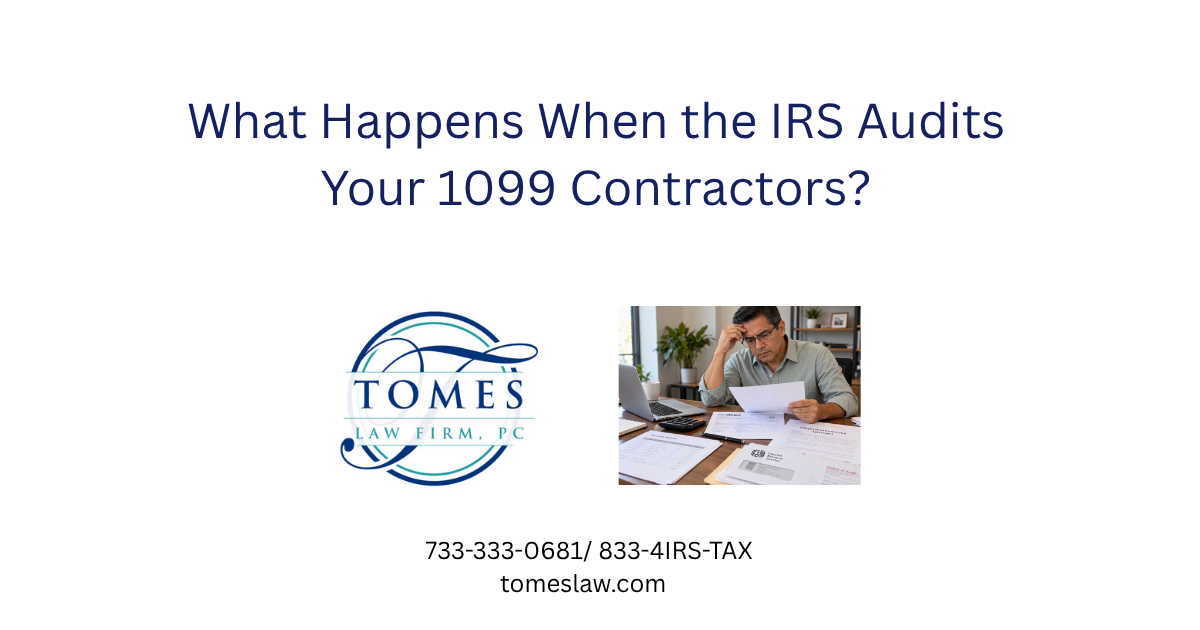
If the IRS examines your independent contractors and determines they should have been employees, your business could face substantial payroll taxes, penalties, and interest.
Many New Jersey business owners believe that paying someone as an independent contractor and issuing a Form 1099 is enough to protect them. Unfortunately, that is not how the IRS determines whether someone is an independent contractor.
The IRS looks at the actual working relationship, not just how the worker was paid or what the parties agreed to call it. And with New Jersey’s updated worker classification regulations now in effect, business owners have another reason to review how they classify their workers.
Why Would the IRS Question My 1099 Contractors?
Worker classification may come up during an IRS payroll tax audit or another examination of the business. For example, an auditor reviewing a company’s expenses may notice substantial payments to independent contractors. The auditor may then examine whether those workers should have been treated as employees.
Questions can also arise from inconsistent tax reporting, worker complaints, or information obtained during other examinations. Your business does not have to be selected specifically for a contractor audit for worker classification to become an issue.
How Does the IRS Decide Whether Someone Is an Employee or Independent Contractor?
The IRS generally considers three categories:
- Behavioral control: Does the business control how the worker performs the job? Does it provide instructions, training, or supervision?
- Financial control: Does the worker operate an independent business? Who supplies the equipment? Can the worker make a profit or suffer a loss?
- The relationship between the parties: Is the arrangement ongoing? Does the worker receive employee benefits? What does the contract say? Are the services a key part of the business?
No single factor automatically determines the answer. A construction subcontractor who operates a separate business, supplies equipment, serves multiple customers, and controls how the job gets done may be very different from a worker who reports to the same location daily and works under close supervision. Calling both workers independent contractors does not make their legal classifications the same.
What Records Does the IRS Request During a Contractor Audit?
An IRS auditor may request:
- Forms 1099-NEC and W-2
- Bank statements and canceled checks
- Contractor agreements and invoices
- Payroll tax returns
- General ledgers and expense records
- Records showing how workers were supervised and paid
The auditor may also ask about the services performed and how the business operates. This is one reason we recommend experienced representation. Records should be organized, reviewed, and presented with an explanation of the actual working relationships. Business owners should cooperate with legitimate audit requests while avoiding incomplete or confusing explanations.
How Expensive Can an IRS Payroll Audit Become? Hector’s Story
We represented Hector, a business owner who paid workers in cash. During an IRS payroll tax audit, the IRS questioned the payments and the business’s reporting of its workers.
Hector faced a proposed assessment of more than $1 million involving payroll taxes and penalties, including penalties related to missing Forms 1099. The amount was devastating for a small business.
We challenged the government’s assessment, including the treatment of worker payments and the calculation of penalties and employment taxes. One of our arguments was that the government could not simply impose overlapping consequences without considering the applicable tax rules and proper treatment of the payments. Through our representation, we substantially reduced the proposed liability.
When an IRS auditor raises questions about worker payments, the first proposed assessment is not necessarily the amount the business legally owes.
Client details have been changed to protect confidentiality. Results depend on the circumstances of each case.
What Happens If the IRS Decides My Contractors Were Employees?
The IRS may propose additional employment taxes, penalties, and interest. The amount depends on the facts, including payments involved, applicable tax years, reporting history, and whether the misclassification was intentional. When numerous workers are involved over several years, potential liability can be significant.
The IRS must still apply the law correctly. An experienced tax audit attorney can review the classification, evaluate available relief, and test the government’s calculations.
Can a Business Fight an IRS Worker Classification Assessment?
Yes. Several potential defenses may be available.
Section 530 Relief
Section 530 of the Revenue Act of 1978 may provide relief from federal employment tax liability for qualifying businesses. The business generally must satisfy requirements involving consistent treatment of similarly situated workers, required information return filings consistent with contractor status, and a reasonable basis for the classification.
Section 530 relief does not automatically protect a business from New Jersey’s separate employment-related laws.
Reduced Employment Tax Rates
When Section 530 does not apply, Internal Revenue Code Section 3509 may permit reduced federal employment tax rates in some worker reclassification cases. Those rates generally are not available when the employer intentionally disregarded withholding obligations.
Challenging the IRS Calculations
Were payments correctly identified? Were amounts counted twice? Were the proper rates applied? Are information return penalties appropriate? Does the IRS have evidence supporting its proposed assessment? These questions can make a substantial difference.
How Are New Jersey’s Independent Contractor Rules Different?
New Jersey business owners face an additional concern. On October 1, 2026, new New Jersey Department of Labor regulations clarifying the state’s existing ABC test became operative.
Under the ABC test, a business generally must establish all three requirements:
- A. The worker is free from the company’s control or direction.
- B. The work is performed outside the usual course of the business or outside all of its places of business.
- C. The worker is customarily engaged in an independently established trade, occupation, profession, or business.
The ABC test applies under important New Jersey employment laws, subject to applicable statutory exceptions. The state’s rules differ from the IRS’s federal classification test. The regulations clarify an existing legal test rather than establishing the ABC test for the first time.
Why Shouldn’t You Handle a Worker Classification Audit Yourself?
An audit involving numerous contractors can become time-consuming. An auditor may request years of records and detailed explanations of workers’ duties, schedules, payments, and working relationships.
For owners of construction companies, restaurants, cleaning companies, and other businesses that regularly use contractors, gathering those records takes valuable time away from running the business.
At Tomes Law Firm, we help business owners organize records, communicate with auditors, evaluate defenses, and challenge proposed assessments when warranted, so they can focus on operating their businesses.
What Should I Do If I Receive an IRS Payroll or Contractor Audit Notice?
Do not ignore the notice. Do not assume your workers were classified correctly merely because they signed agreements or received Forms 1099. Have the notice and records reviewed by an experienced tax audit professional before making substantive representations about your worker arrangements.
An audit notice does not automatically mean your business did anything wrong. But how you respond can affect the outcome.
Facing an IRS Payroll Tax or Contractor Audit in New Jersey?
At Tomes Law Firm, we represent New Jersey businesses facing IRS payroll tax audits, worker classification disputes, and New Jersey Department of Labor audits. We investigate facts, organize records, analyze defenses, and work toward resolving audits with minimal unnecessary disruption.
We Solve Tax Problems. You Get Peace of Mind.
Contact Tomes Law Firm at tomeslaw.com to discuss your audit.
Frequently Asked Questions
Can the IRS audit my business if I only pay 1099 contractors?
Yes. Even a business without W-2 employees can be examined to determine whether its workers were properly classified.
Does a signed contractor agreement protect me from an IRS assessment?
Not necessarily. The IRS considers the actual working relationship, not just the written agreement.
What happens if I paid contractors in cash?
Cash payments are not automatically improper, but the business must maintain appropriate records and comply with applicable tax reporting rules.
Can I challenge an IRS assessment for misclassified workers?
Yes. Depending on the facts, you may dispute the classification, seek applicable employment tax relief, challenge calculations, or pursue appeal procedures.
Are New Jersey’s contractor rules the same as the IRS rules?
No. New Jersey generally applies its ABC test under relevant state employment laws, while the IRS uses a federal common-law analysis.
Can the IRS audit several years of contractor payments?
Yes. The years subject to examination depend on applicable limitations periods and the circumstances.
Official Resources
IRS: Independent Contractor or Employee
IRS: Section 530 Worker Reclassification ReliefNew Jersey Department of Labor: 2026 Worker Classification Regulations